
7. AI: A Normal Technology?
AI in the Workplace

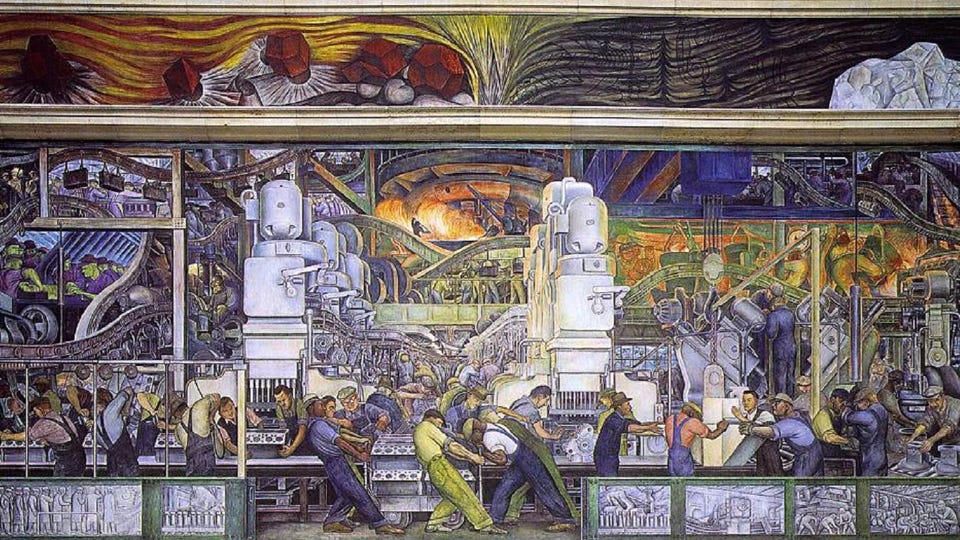
This is week seven of AI in Finance at NYU Stern (lecture slides here and last week here). We start with the iconic Diego Rivera Industry Murals. These depict the process of mass production and industrialization, based on Ford’s massive River Rouge complex, with workers and machines tangled together in a web of production. Rivera’s murals were painted in the depth of the Great Depression, and admit many possible interpretations: the wonder of modern industrial production, as well as Marxist notions of class conflict.
From the standpoint of this class, these murals reflect the challenges inherent in even “normal” technologies, a term we will get to. Industrial development was transformative, but did not diffuse instantaneously. Frictions and hurdles led to large lags in industrial growth, and much of the world still lags behind the dissemination of these technologies. Industry disrupted many workers, while creating new jobs and tasks.
The basic question for today is: will AI be the same? That is, will it be a “normal” technology? Or is it going to be something weirder? And where do the rents go depending on how normal it is?
The Case for Normal
Of course, this all hinges on what “normal” means in the first place. This is set out in a wonderful essay by Arvind Narayanan and Sayash Kapoor which makes the affirmative case for “AI as a Normal Technology” in one of the most influential articles about AI, ever.
By “normal” technology they mean a technology with transformative general purpose potential, but whose actual use and diffusion throughout the economy is rate-limited by a host of frictions, which both limit the downsides as well as upside potential. A normal technology, in this view, certainly has the ability to radically reshape the economy over time, as indeed did industrialization. But even AI, which appears unique in several aspects of rapid growth potential, is going to be limited (in their view) by a variety of real-world frictions which wind up making it “normal,” includinng:
The limits to diffusion set by human, organizational, regulatory, and institutional change
The limited value of conventional “benchmarks” in assessing real-world usefulness of AI tools to business tasks
The economic feedback loops in response to automation, which will divert human resources and talent towards newer problems
Note that this framework does not suggest risks are entirely absent: they discuss several, and indeed the regulatory frictions come exactly because human institutions respond to real risk through policy solutions. A key statistic in favor of their view is that, at least as of August 2024; 40% of adults had used AI, but people used it so infrequently it only made up 0.5-3.5% of work hours.
The basic argument against this perspective is that there are sufficiently weird or distinct aspects of AI which mean its influence is going to be decidedly non-Normal. This might happen, for instance, if we hit recursive self-improvement (RSI): if the models start building themselves and growth rates hit exponential. Alternatively, AI may look normal for some period of time, but after it is finally able to automate every last function that humans can do, we then fully automate the entire economy, and have no need for humans.
How People Use AI
For one guide into the “normality” of AI, we can look at how people tend to use it. A classic and early guide here is a McKinsey study which estimated $2.6-4.4 trillion in value. In Finance, they highlighted banking and insurance, customer service, and underwriting. McKinsey emphasizes bottlenecks of organizational frictions, risk management, and data infrastructure, not just raw model performance.
The Anthropic Economic Index also gives us one guide to adoption. One of their interesting findings is that the quality of the output you get from AI is a function of the inputs, which suggests there are real returns to skill in AI proficiency. You see that across countries, because high-income countries (Canada, Nordics, Singapore) tend to use AI in ways that are more augmenting or complementing in nature, while low-income countries use AI for coding and technical tasks. Augmented conversations in general have been rising, as product changes like skill files, project folders, and persistent memory push people towards more human-in-the-loop operations.
Another related result is that the correlation between the education level implied by the user’s prompt and that of the AI response is quite high; around a 0.93 correlation across countries or US states. What you prompt is what you get. This suggests that another bottleneck (and source of rents/profits) is likely to remain human intelligence, to the extent it continues to unlock higher quality AI output.
There are similar results with ChatGPT’s data as well. You see some signs of the bifurcation between Claude as an Enterprise workhorse, and ChatGPT becoming a dominant consumer player; with 10% of the world’s population using ChatGPT by mid-2025, and a rising share of the topics related to non-work content. For Finance applications, it seems like there is a lot of bottom-up incorporation of AI tools into workflows by analysts, PMs, and risk managers (as opposed, for example, to firms pushing top-down AI rules).
Restructuring Firms
This pattern of usage is suggestive that we are going to face really severe organizational frictions to the broader adoption of AI tools, and ultimately probably need to restructure organizations substantially to get the most out of the tools. A paper by Yotzov, Barrero, Bloom, Bunn, Davis, and coauthors gives us one firm-level perspective by surveying 6,000 executives across the world. AI usage at some level is pretty common (69% of firms actively using AI); but executives only use 1.5 hours/week. Firms don’t think AI has changed that much so far; but going forward they project +1.4% productivity, +0.8% output, and -0.7% employment. Their employees, meanwhile, think there will be a rise of +0.5% in employment, so someone is going to be wrong on the employment impacts.
Another survey from Baslandze, Edwards, Graham, and coauthors similarly documents rising interest; finance firms went from a 59% investment rate to 82% between 2025 and 2026. Some of the remaining points of friction include workforce training, privacy concerns, and insufficiently advanced AI technology. They find a productivity paradox: the perceived gains are larger than the realized ones, which they think reflects a lag in revenue realization (it could also be misperceptions of AI’s benefit for them). They also find interesting patterns of where AI is augmenting tasks compared to replacing them. AI enhances higher-order business functions (marketing, finance, and accounting) while replacing operational tasks (data entry, routine tasks, administrative), and so clerical staff are down while skilled technical roles are up.
One clue on the broader organizational shifts required comes from a paper on “Corporate Hierarchy” by Michael Ewens and Xavier Giroud. They construct organizational charts for over three thousand public firms using LinkedIn data (the network estimation technique alone is pretty interesting; hierarchical “layers” are estimated by looking at which roles people tend to come from and go to over their careers). The key finding is that firms have, on average, around ten layers of hierarchy; but AI adoption tends to lower the number of layers. It makes some intuitive sense if you think that the role of additional layers is to function as “problem solvers” to address complex problems faced by lower-layer employees, and AI can now handle some of those tasks. But suggests another wrenching economy-wide transition as firms are going to have to slowly figure out how to reconstruct their org chart assuming workers have access to AI.
We can also look to stock markets for some guide to what the market is pricing in. A paper by Andrea Eisfeldt, Gregor Schubert, and Ben Zhang generates a measure of firm workforce exposure to AI, and finds the market is basically pricing in some degree of worker substitution.
Task Chains, and Fixing the Slow Part
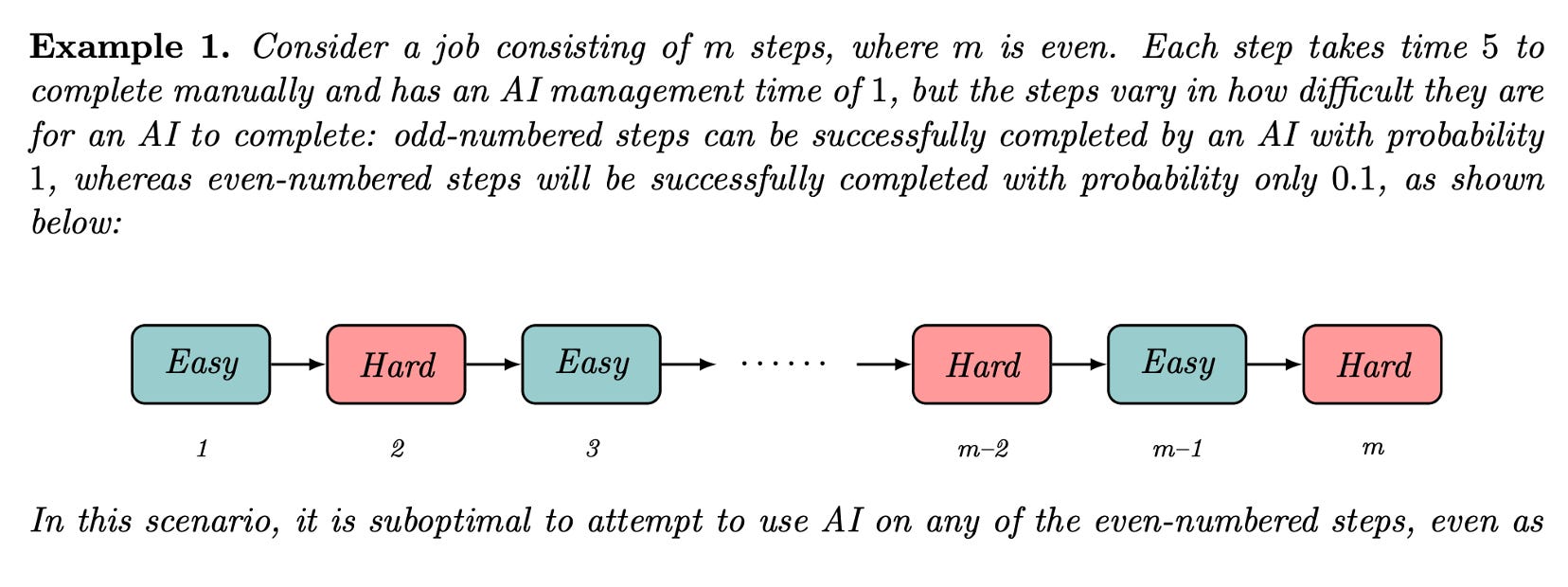
This brings us to another really influential paper on how frictions can hold back production with AI, and how we need to rethink our process. This is the task chaining paper by Demirer, Horton, Immorlica, Lucier, and Shahidi. They think about production as a series of steps which can be manual, augmented, or fully automated. AI is going to do great when you you can sequence a large number of connected simple steps into “chains.” Firms then bundle the steps and chains into tasks and jobs trying to balance specialization and trading costs.
The key idea is that AI is going to really fail when you have to interweave hard and easy tasks one after the other, because the coordination of involving the AI escalates the cost even though there is a comparative advantage for the AI to handle it.
By contrast, if you can cluster the easy steps into one big step, you can handle them all in one go with AI, and leave some of the harder steps (perhaps involving verification or more judgement) for humans at the end.
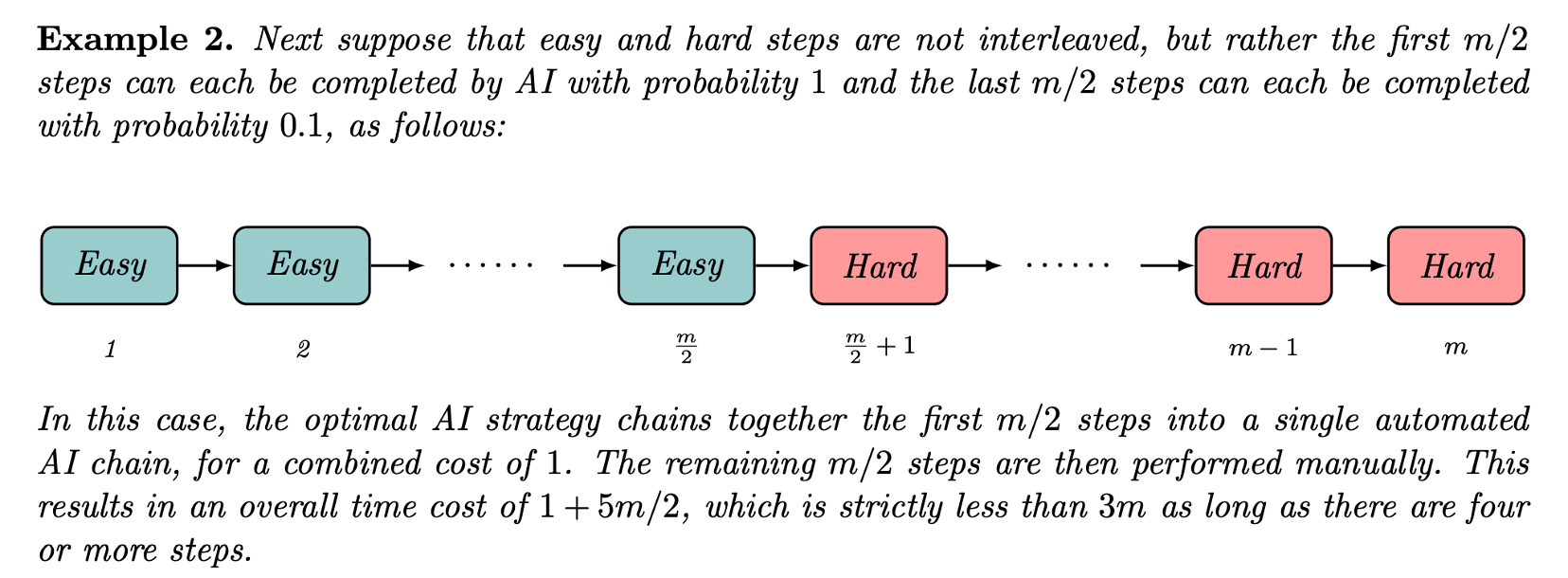
The implication for firms is that the benefits of AI investments are likely to be low at first, but then really escalate after you pass some threshold and you are now able to automate a much larger set of steps, perhaps after you reconfigure your production system to put all the easy steps together. This comes back to one of our key themes: figuring out and improving the “slow part” of a system can yield really large returns.
This raises a natural question though: how exactly are you supposed to find the value of AI in your production chain? Kim, Kim, and Koning call this the mapping problem and test this with a clean field experiment across 515 high-growth startups. The treatment is just information: they tell firms how other firms reorganized production around AI. This simple intervention alone results in 44% more discovered use cases, especially in product development and strategy. Treated firms actually cut back demand for external capital heavily, by 39.5%, while their labor demand stayed flat. Some follow-on work suggests that AI-native firms, those that start with AI already available, have fewer workers (especially entry-level workers), flatter hierarchies; reflecting different production technologies optimized around AI from the beginning.
The broader point here is that firms face a whole range of bottlenecks around actually deploying AI into production, and these are unlikely to be fixed (at least in the short-run) by just improving model quality. The upshot is that the effective diffusion of AI across the economy is likely to be limited by information access and production systems. Companies that struggle to gather and organize the right contextual data are going to suffer, especially when this tacit and diffuse information is really important for business success.
Implications for Productivity
The big question here is ultimately productivity: how much is AI going to actually increase this? A major study here is the METR experiment which conducted a high-quality randomized trial given some developers access to AI tools in 2025, to see the impacts on task speedup. They surveyed experts about the likely productivity gains, who dutifully said they expected to see one (disclosure: I was one of the people surveyed, and I also thought there would be some productivity benefits). The developers themselves thought AI was effective. The actual result, remarkably enough, was a 20% slowdown in productivity.
Subsequent followups were more positive, but METR itself is upfront that selection makes this harder to analyze. Developers now often refuse to work without AI, making it hard to establish a non-AI benchmark.
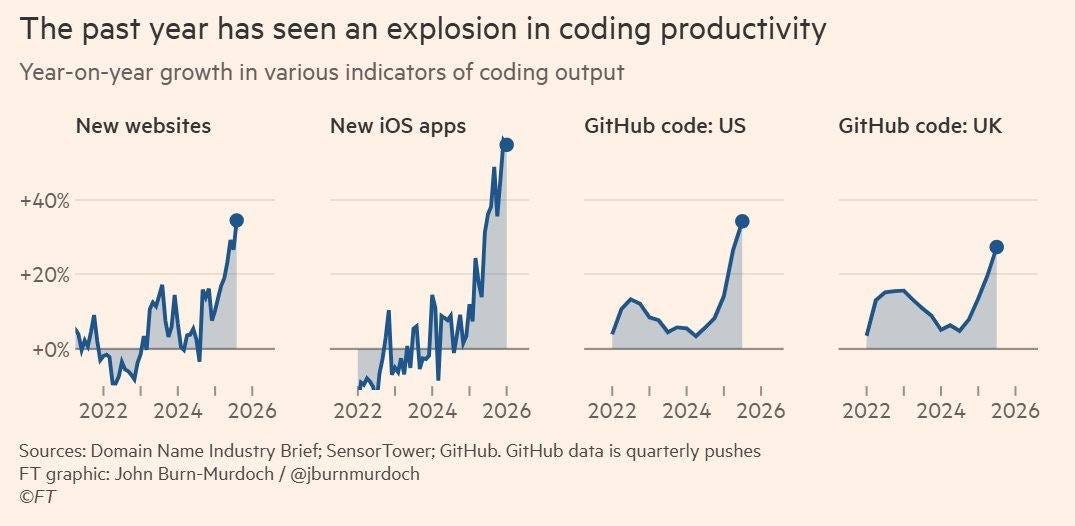
So that’s surprisingly bad news in arguably one of the best conducted studies in this space. Yet, as the developer revealed preference shows; AI use is everywhere. And we have a lot of aggregate indicators showing growth. The FT’s John Burns-Murdoch highlights the rise in websites, iOS apps, and GitHub code. One firm’s internal data suggests AI-generated code going from 3,000 lines in March 2025 to 2.26 million by August, of which 40% is shipped to production and PR cycle times having gone down. Blick, Blandin, and Deming find that industries where workers report more AI time savings (including information, finance, and insurance) also report higher detrended productivity growth. It’s hard to make sense of all of this together, by my read is we have real gains in specific workflows (especially coding-related), which are overstated in simple demos, and are slow to bubble up to the aggregate level.
On the question of distribution across workers, a consistent finding is leveling. Brynjolfsson, Li, and Raymond’s Generative AI at Work looks at the effects of AI access for customer service workers. Everyone benefits, but the largest largest gains go to less-experienced, lower-skilled workers. Cruces, Fernández Meijide, Galiani, Gálvez, and Lombardi find something similar in another randomized trial outside of firms; AI closes about three-quarters of the gap in productivity due to education at a problem-solving task.
Note there is an interesting tension here with the macro-style results Anthropic has reported overall. AI reduces skill inequality in the micro data, while increasing it in the macro data because at the macro level workers decide whether not to adopt. If you can force all workers to use AI, the skills gap might decrease; but higher-skilled workers tend to be faster adopters, so the net impact on inequality is a bit ambiguous.
Learning from History
It’s helpful to look back at history for other guides as to what “normal” technological disruption led to. One interesting historical relic is the “knocker-upper.” As factories moved to production shifts, workers had to start getting up at specific times. The knocker-upper was a person hired to wake up these workers, typically using peashooters or sticks to knock on people’s doors (knocker-uppers themselves sometimes relied on other knocker-uppers to wake themselves up; or were night owls). Obviously this went away as we developed alarm clocks. There are a whole set of professions like this: elevator operator, etc.

However, sometimes the pace of disruption is slower than you might think. The rise of ATMs did not kill the role of bank teller, despite worries at the time (i.e., the New York Times suggested in 1973 that ATMs might replace three fourths of tellers). Instead, cheaper branches meant that bank tellers specialized in providing higher-value services and actually grew in employment. It took until the iPhone before we saw a more complete disruption of bank tellers.
Another great example of augmentation-replacement-upgrading is the spreadsheet. The rise of new spreadsheet software: VisiCalc, Lotus 1-2-3, and Microsoft Excel first lead to a rise in employment for bookkeepers (a complementary or augmenting technology), until the technology got good enough to replace these workers. However, having well-kept financial books now enabled new occupations: accountants, auditors, management analysts, and financial managers to really take off. Andreessen and Horowitz make a more general point: the vast majority of today’s jobs are in occupations which didn’t exist in 1940.
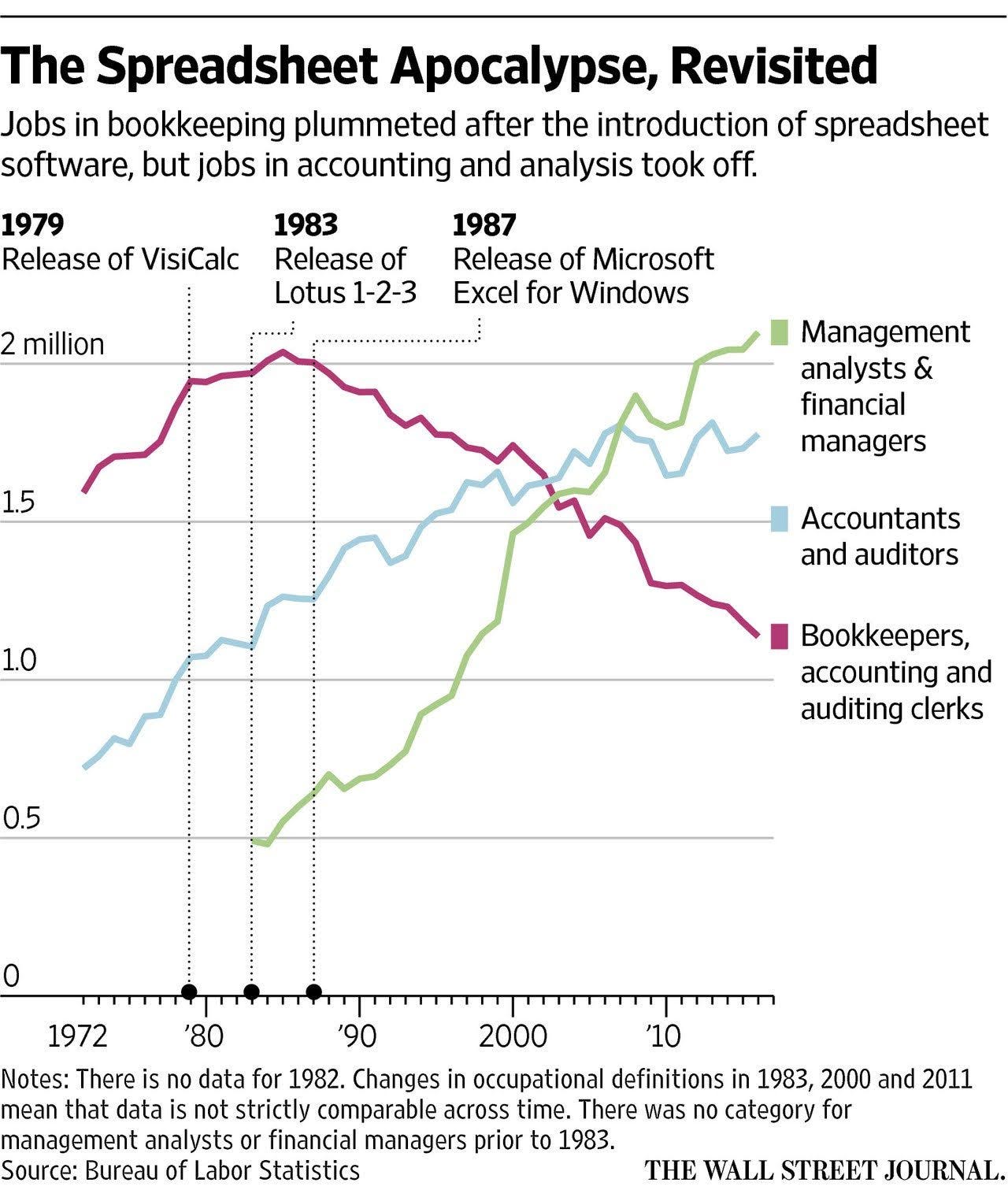
These are all positive reasons from historical experience that suggest technological shifts have generally both expanded the pie as well as created totally new job categories along with them.
But there are a few more negative analogies too. There is the Engels pause: the fact that British GDP per capita rose from 1790-1840 while real wages were flat. There is deindustrialization in Northern American cities, which led to an urban doom loop as white collar work only slowly replaced blue collar work in cities. We haven’t yet seen labor displacements on this scale with AI. There is plenty of research suggesting that young workers in particular seem to be losing out, but even the mechanisms here are unclear (ChatGPT coinciding with a hiking cycle doesn’t help; then there is the congestion in labor market applications, partially AI driven).
A Normal Technology After All?
We close with Keynes’ famous essay on Economic Possibilities for our Grandchildren, written right around the same time as Rivera’s murals were painted. He wrote that in the midst of the Great Depression, a huge episode of what he correctly understood to be temporary unemployment. He predicted living standards four to eight times higher within a century, and forecasting a fifteen-hour week, since “three hours a day is quite enough to satisfy the old Adam in most of us.” He was more or less right about the living standards, but way off on the leisure part.
One part of being a “normal” technology is, ultimately, producing enough riches so we can enjoy our free time. In that area, at least, we have some interesting work by Blank, Schubert, and Zhang who find ChatGPT adoption raises individual leisure browsing, while leaving total digital time unchanged. So at home, at least, the Keynesian leisure dividend is there. But at work, the old Adam in us is intensifying efforts.
Whether AI is liberating or further entangling humans remains as enigmatic as Rivera’s murals, and there is room for many views. So far, AI is replacing some directly substitutable tasks, augmenting many more, and running into the same frictions that have throttled other general purpose technologies before it. These frictions will limit the gains, but also mercifully the losses as well. But there are a few risks on the horizon difficult to fully ignore: the loss of entry-level work, the social and economic ramifications of broad white-collar job loss, and the ever-advancing nature of scaling laws which make it ever harder to assume the comforting historical analogies hold.